If you run an ecommerce brand and don’t have a mobile app yet, you’re not alone. Most stores still operate on the assumption that a mobile app is still only something for huge brands, who can afford to spend $300K on a custom development project.
That assumption was true in 2018. It’s not true now.
There are more realistic ways to launch a mobile app for an ecommerce store today. You can build and launch your app in a matter of weeks (not 6+ months), and without a huge budget and the bandwidth of managing a massive project yourself.
Why Your Ecommerce Store Needs a Mobile App
An app does one thing for an ecommerce brand that nothing else in the marketing stack does: it gives you a direct, owned channel to your best customers.
That sentence does a lot of work, so it’s worth unpacking.
“Direct” means there’s no algorithm sitting between you and the customer. Push notifications land on the phone in real time. The app icon sits on the home screen alongside Instagram and the bank. You don’t need to outbid a competitor for an impression, hope your email lands in the primary inbox, or pray the platform doesn’t tweak its feed weighting next week.
“Owned” means the channel survives anything that happens to the third-party platforms you rely on. iOS privacy changes have already taught most operators what happens when an attribution channel quietly stops working. Apps aren’t subject to that. The relationship runs between you and the customer.
“Best customers” is the most important phrase in the sentence. App users are, by definition, your best customers. They’re repeat buyers. People don’t download apps from brands they bought from once and forgot about. They download apps from brands they’ve decided are part of their routine. That’s the population an app reaches, and that population is responsible for an outsized share of your revenue.
The economic picture is simple. Customer acquisition costs have been climbing for years and aren’t reversing. The brands holding margin are the ones increasing LTV from existing customers faster than CAC is climbing.
An app is one of the better tools for doing that, because it makes the customer relationship more habitual: more frequent visits, larger basket sizes over time, and a higher likelihood of being there when the customer is ready to buy.
That’s the case. Now the practical question: what does it look like to launch one?
What “Turning Your Store Into an App” Means
Most founders think about building an app the way they’d think about building a second business. New product, new design, new content, new operational surface. That mental model is what makes the project feel insurmountable, and it’s wrong for almost every ecommerce brand.
A mobile app for an ecommerce platform, at the simplest, delivers a similar experience to what your website already delivers (same products, same pricing, same content, same checkout) in a native app on iOS and Android. Customers tap your icon, see your catalog, browse, and buy.
It should be consistent. Customers shouldn’t see a completely different store depending on which channel they buy from.
That’s the default. You can layer optimizations on top – a cleaner home screen built for repeat buyers, a faster reorder flow, app-only offers, push notifications for back-in-stock and abandoned cart – and most successful apps do. But none of that is a prerequisite. You can launch with a near-mirror of your site and improve from there.
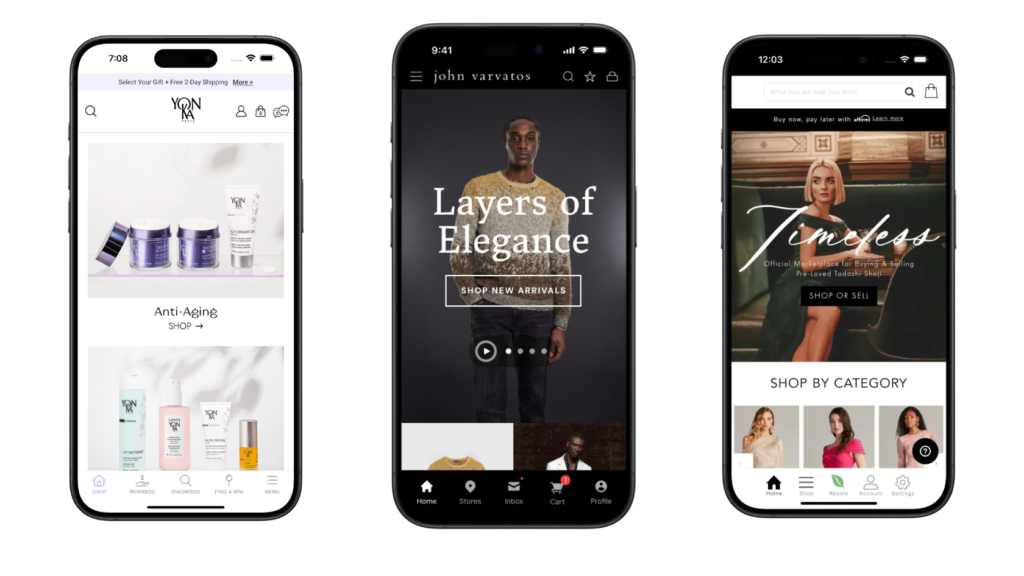
The value of the app isn’t that it’s a fundamentally different product. It’s that the same experience is much more convenient when it lives on a customer’s home screen instead of behind a Safari bookmark.
Less typing. Faster loading. No friction at checkout. A push notification can drive a visit in five seconds. Each of those is a small thing on its own. Added up across a year of customer interactions, they compound into measurably higher repeat purchase rates and bigger AOVs from the same customers.
Two Ways to Launch a Mobile App for Your Store
The biggest reason ecommerce brands skip the app conversation is the assumption that an app means an expensive and difficult custom build. They think you need to hire developers to code it, and build a whole new team to manage it.
Today, that’s not necessary. There are two ways to turn your ecommerce store into an app that don’t require developers, and make it feasible for any ecommerce brands to have their own branded mobile app.
Let’s look at them now.
Option 1: No-Code App Builders (For Smaller, Simpler Stores)
This is the best way to launch an app for small-to-mid Shopify brands with a relatively standard setup.
These are subscription tools you configure yourself, typically starting in the low hundreds of dollars per month. You connect them to your Shopify store, configure the look and structure of the app, and submit it to the App Store and Google Play. There’s a learning curve, but the heaviest lift is design and configuration decisions, not engineering.
It’s a maturing product category: there are close to a hundred mobile app builders in the Shopify App Store. All work much the same way, connecting with Shopify and various apps via API, to let you publish a mobile app without coding.
It’s worth mentioning that most tools only work with Shopify. Outside Shopify, the no-code market thins out considerably. There are some options on BigCommerce and WooCommerce, but nowhere near the same selection.
The tradeoff with no-code is that you’re working within a template. The tool decides what your app can do you decide how to use what’s available.
For straightforward Shopify stores with standard product catalogs, that’s usually enough. For brands with custom checkouts, B2B alongside DTC, multi-region storefronts, complex integrations, or non-standard catalog logic, the template starts to bend in ways that limit what the app can be.
Option 2: A Managed App Service Like MobiLoud (For Larger, More Complex Stores)
Once a brand is past the standard-Shopify tier – on Shopify Plus, Magento, BigCommerce Enterprise, Salesforce Commerce Cloud, Shopware, or a custom/headless stack – no-code tools likely won’t be enough.
These tools can’t keep up with the needs of more complex brands. These brands need a custom app, but without the tax of a “from scratch” custom build.
A managed mobile app service like MobiLoud is the best solution for custom ecommerce brands. A service like this will build a custom app for your brand, on top of your existing web technology.
This is the key difference to no-code or custom development. Instead of building a mobile app separately from your website, and integrating them, you build an app that extends what your site already does.
That’s what makes it such a good fit for custom ecommerce brands, especially brands in the mid-market to enterprise bracket. These brands have more complicated needs, but a true “website to app” solution, building on top of what already works, means you don’t need to sacrifice the complexity that drives sales on your brand’s website.
How Long It Takes to Launch an Ecommerce Mobile App
When you don’t need to go through a fully custom build, the time it takes to launch a mobile app shrinks dramatically.
You can launch within weeks, or at the longer end, just a couple of months. Typically, a custom build takes a minimum of 6 months, and that’s if everything goes well.
No-code launches are bounded mostly by your own decisions: how long you want to spend designing the app, configuring features, and getting comfortable with the tool. The configuration work itself can be done in a few days; the longest part of the process is usually waiting on Apple’s app review (typically a few days to a couple of weeks, with the occasional rejection that requires a resubmission).
A custom app service will likely take a little longer, as you’re working with more customizations than a no-code template. Depending on the complexity, it could take anywhere from a few weeks to two months.
In any sense, turning your website into an app – instead of building a brand new app from the ground up – changes the game completely. When you can start promoting your app and getting downloads within a month or two, it’s a much easier decision to launch than it is if you’re not going to see the first version until sometime next year.
How to Get Customers to Install Your App
Launching your app is now the easy part. Getting your customers to install it is where the work compounds.
The good news is that you almost never need to spend on paid install campaigns to seed an app. Your existing customer base is your highest-converting install audience, and you reach them with the channels you already use.
A launch playbook for an ecommerce brand looks something like this:
- Email and SMS announcement to your existing list, explaining what the app does for them (faster checkout, exclusive offers, order tracking, whatever applies)
- Site banner prompting mobile web visitors to download the app. The bulk of installs in the first month usually come from here.
- Checkout and account pages nudging customers who are clearly engaged to install the app for next time
- Post-purchase flow including an app prompt in the order confirmation email or page
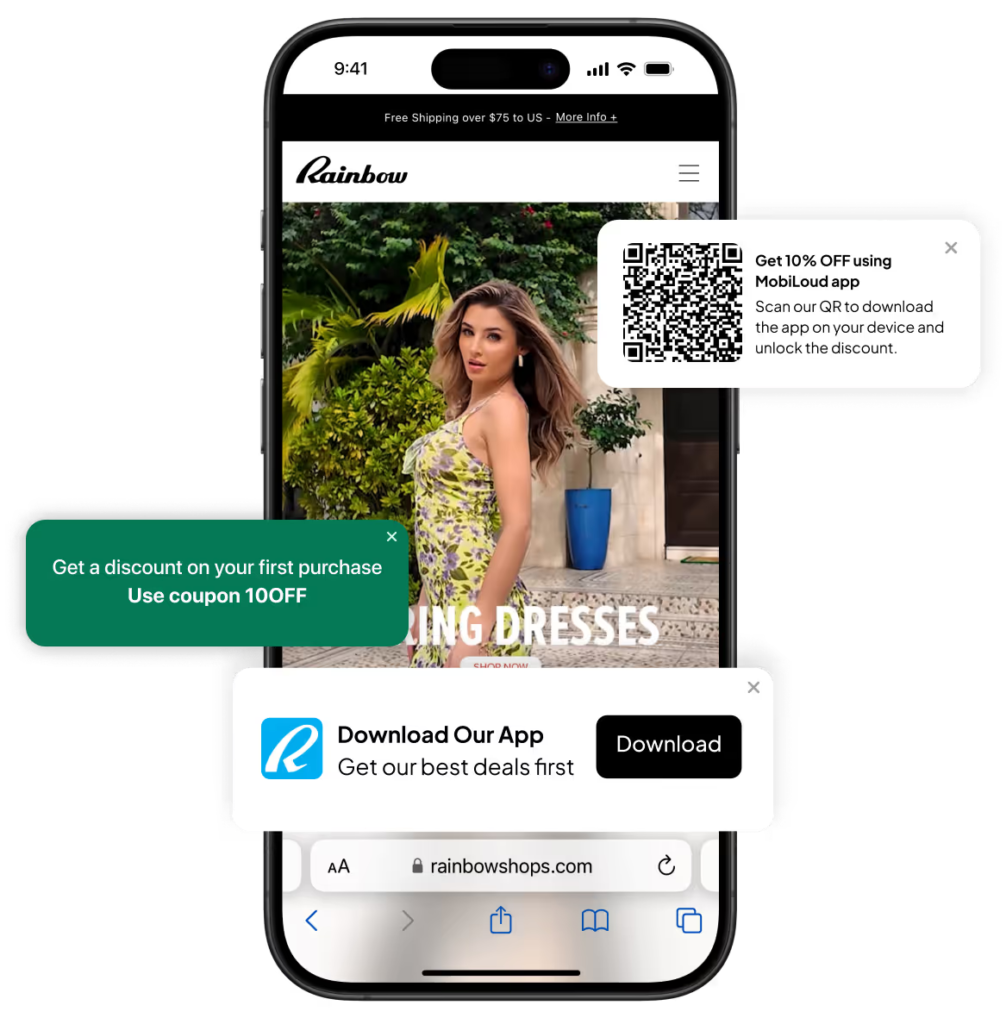
After launch, sustained install growth tends to come from a small set of plays. App-exclusive offers (early access, app-only discounts, members-only drops) give existing customers a reason to install rather than continue on web. Push notifications for back-in-stock and order updates earn the app a permanent slot in the customer’s routine. Integration with your loyalty program, if you have one, gives customers a structural reason to open the app regularly.
You don’t need a huge number of customers to download your app for it to be a success. Just a small, engaged user base and you’ll have an asset that contributes meaningful revenue to your bottom line.
Where to Start
The mobile app question for an ecommerce brand isn’t really “can we afford to build one.” For most stores, the build cost stopped being the barrier years ago.
The real question is how you’re going to get there. No-code app builders and managed app services are both viable ways to launch a mobile app, with neither one attached to a six-figure development cost, and the recurring maintenance load of a custom app.
The customers you already have are spending more of their time inside apps every year, and an app gives you a structural way to be part of that without renting access from someone else’s platform. The case for launching has gotten clearer every year. The case for waiting hasn’t.