Seventy-four percent of brands plan to increase their influencer marketing budgets in 2026. That sounds like good news until you consider the other side of it: bigger budgets attract bigger scrutiny. Finance teams want attribution. Leadership wants revenue numbers, not engagement screenshots. And the platforms that can’t connect creator activity to actual sales are getting cut.
For eCommerce brands, this pressure is even more acute. You have transaction data. You have order values. You have customer acquisition costs. The expectation isn’t just that influencer marketing works – it’s that you can prove exactly how well it works, per creator, per campaign, per dollar spent.
Upfluence has eCommerce integrations, but its mandatory annual contracts, smaller database, and workflow limitations make it harder to scale the kind of data-driven influencer program that modern eCommerce teams need. If your current setup can’t connect a creator’s Instagram post to a Shopify order with a clear attribution chain, it’s time to look at what else is available.
Here are 10 platforms evaluated specifically for eCommerce teams:
- Influencer Hero
- GRIN
- Modash
- Aspire
- Storyclash
- HypeAuditor
- Later
- Meltwater
- Heepsy
- SocialLadder
Why eCommerce Brands Are Moving Away From Upfluence in 2026
Upfluence has genuine eCommerce strengths – Shopify and Amazon integrations, a performance CRM, and Jace AI for outreach. But several structural issues make it a poor fit for eCommerce teams that need to scale:
- Mandatory Annual Contracts: Plans start at $24,000+ per year for two seats with no free trial. In eCommerce, where seasonal testing and rapid iteration are the norm, locking into a 12-month contract before you’ve validated the platform is a significant risk.
- Database Size Gap: Upfluence indexes 12M+ influencers. Competitors now offer 200M-450M+. For eCommerce brands chasing niche product categories – specific skincare ingredients, sustainable fashion, specialty food – that gap directly limits how many relevant creators you can find.
- Limited Search Precision: Only 12 discovery filters versus 37+ on some alternatives. When you need creators who match specific audience demographics, price points, and content formats, fewer filters mean more manual sorting.
- No Self-Service Evaluation: You must go through a sales demo to see the product. For eCommerce teams accustomed to trying software before buying, this creates friction and slows down decision-making.
Best Upfluence Alternatives for eCommerce Brands in 2026
1. Influencer Hero
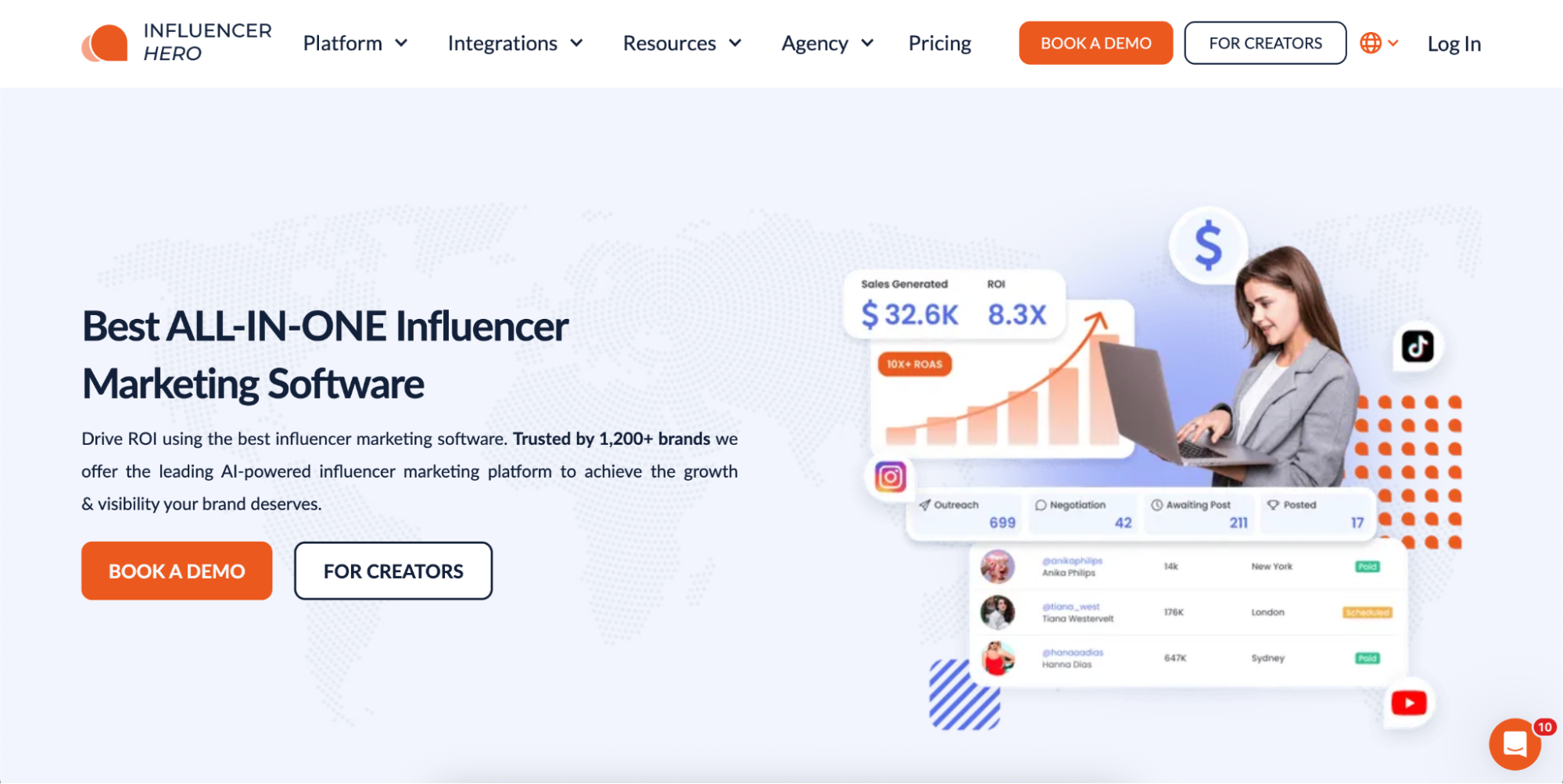
Influencer Hero is built around the eCommerce use case from the ground up. Every stage of the influencer workflow – discovery, AI-powered outreach, CRM, product gifting, UGC collection, affiliate tracking, analytics, and creator storefronts – operates within a single system with native integrations across five eCommerce platforms. For brands that need a direct line from creator partnership to revenue attribution, it’s the most complete option on the market.
Best for: eCommerce brands that need end-to-end influencer workflow automation with native integrations across Shopify, WooCommerce, Magento, BigCommerce, and Prestashop.
Pricing:
- Standard: $649/month (1 seat, up to 1,000 creators, 1,000 outreach/mo)
- Pro: $1,049/month (3 seats, up to 5,000 creators, 5,000 outreach/mo)
- Business: $2,490/month (8 seats, up to 10,000 creators, 10,000 outreach/mo)
- Custom & Agency plans available with unlimited outreach
Standout features:
- 450M+ Creator Database Across 8 Platforms: Instagram, TikTok, YouTube, Pinterest, Snapchat, Twitch, and X with audience quality scoring – the widest discovery net available for finding niche product-market fits.
- AI-Powered Outreach (43% Response Rate): Automated drip campaigns with AI-personalized first lines based on each creator’s recent content. Eliminates the outreach bottleneck that slows down product seeding campaigns.
- Product Gifting via Shopify: Send products directly from your CRM through Shopify fulfillment. Creators select items, orders ship automatically, and the entire gifting pipeline is tracked in one place.
- Automation Engine: Rules-based triggers that auto-generate Shopify discount codes on contract sign, advance creators through pipeline stages, and fire actions based on campaign milestones.
- Creator Storefronts (Up to 8x ROI): Branded storefronts where creators showcase and sell your products with affiliate commissions – turning influencer partnerships into a persistent sales channel.
- Per-Creator Revenue Attribution: Track exactly how much revenue each creator generates through affiliate links, discount codes, and storefront sales across all integrated eCommerce platforms.
The platform’s feature depth means teams new to influencer marketing software may need onboarding time. Brands running only a handful of campaigns per year might not leverage every capability, though the all-in-one architecture means you won’t outgrow it as your program scales.
2. GRIN
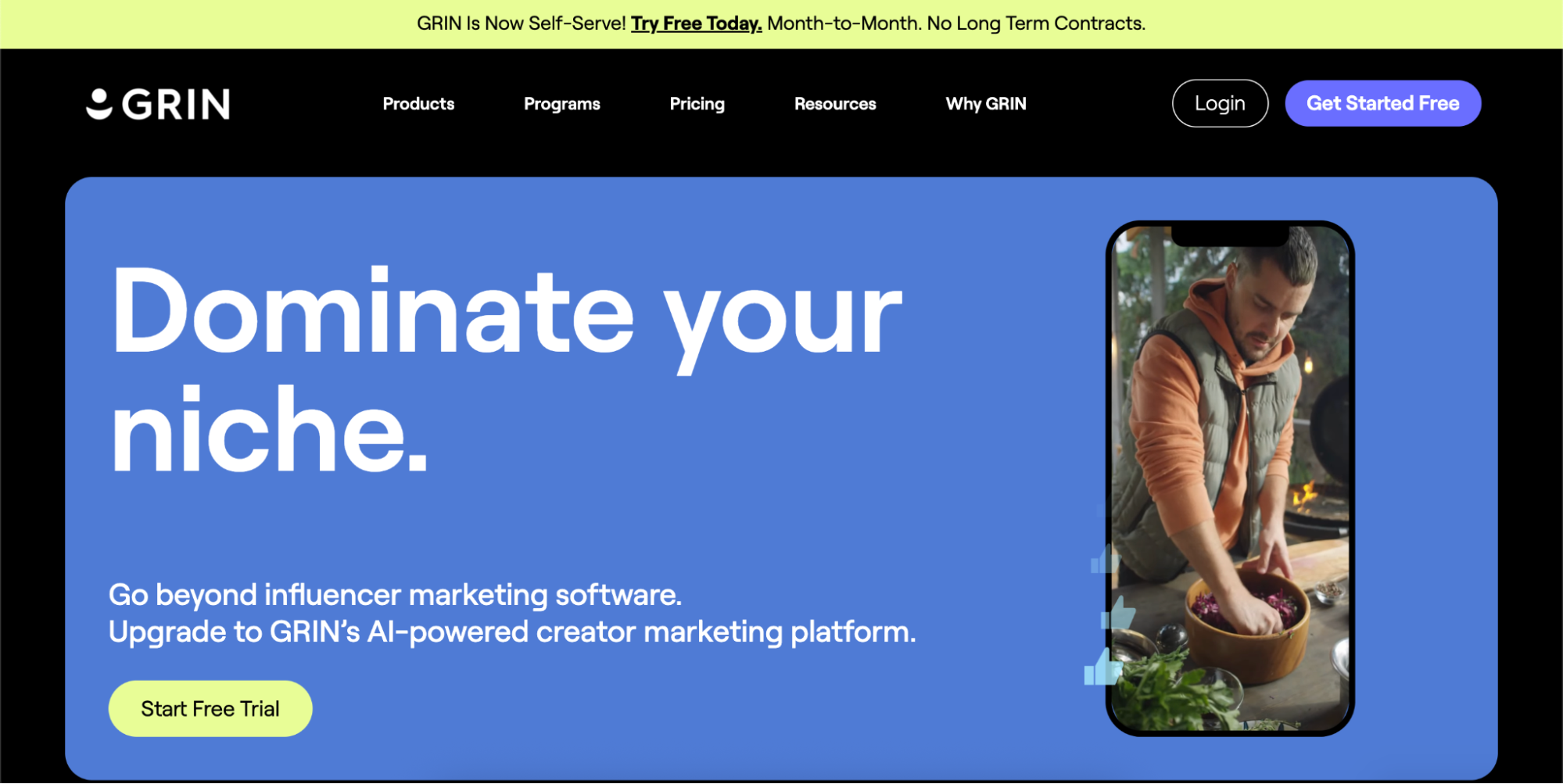
GRIN is an enterprise-grade platform purpose-built for eCommerce and DTC brands. Unlimited creator partnerships, native Shopify integrations, and automatic media rights management make it a serious option for established brands with the team and budget to support its pricing structure.
Best for: Established DTC brands with dedicated influencer teams running high-volume seeding and ambassador programs through Shopify.
Pricing:
- Custom; entry tier typically starts around $2,500/month
- 12-month minimum commitment
- Annual cost typically $25,000+/year
Standout features:
- Unlimited Creator Partnerships: No caps on influencer count – built for brands running hundreds of partnerships simultaneously.
- Native Shopify + PayPal: Product shipping and creator payments handled through direct platform integrations.
- Creator Portals: Private dashboards where influencers view briefs, submit content, and track their earnings.
- Automatic Media Rights: Content reuse rights built into the booking flow – no separate licensing step for repurposing UGC in ads.
- UGC Library: Searchable content repository including Stories, organized for cross-channel repurposing.
GRIN’s $25,000+/year commitment and 12-month minimum mirror the contract structure that pushes many brands away from Upfluence. Its eCommerce integrations are limited to Shopify – WooCommerce, Magento, and BigCommerce brands are out. The platform doesn’t publish its database size, making it hard to compare discovery breadth against competitors indexing 350M-450M+ profiles.
3. Modash
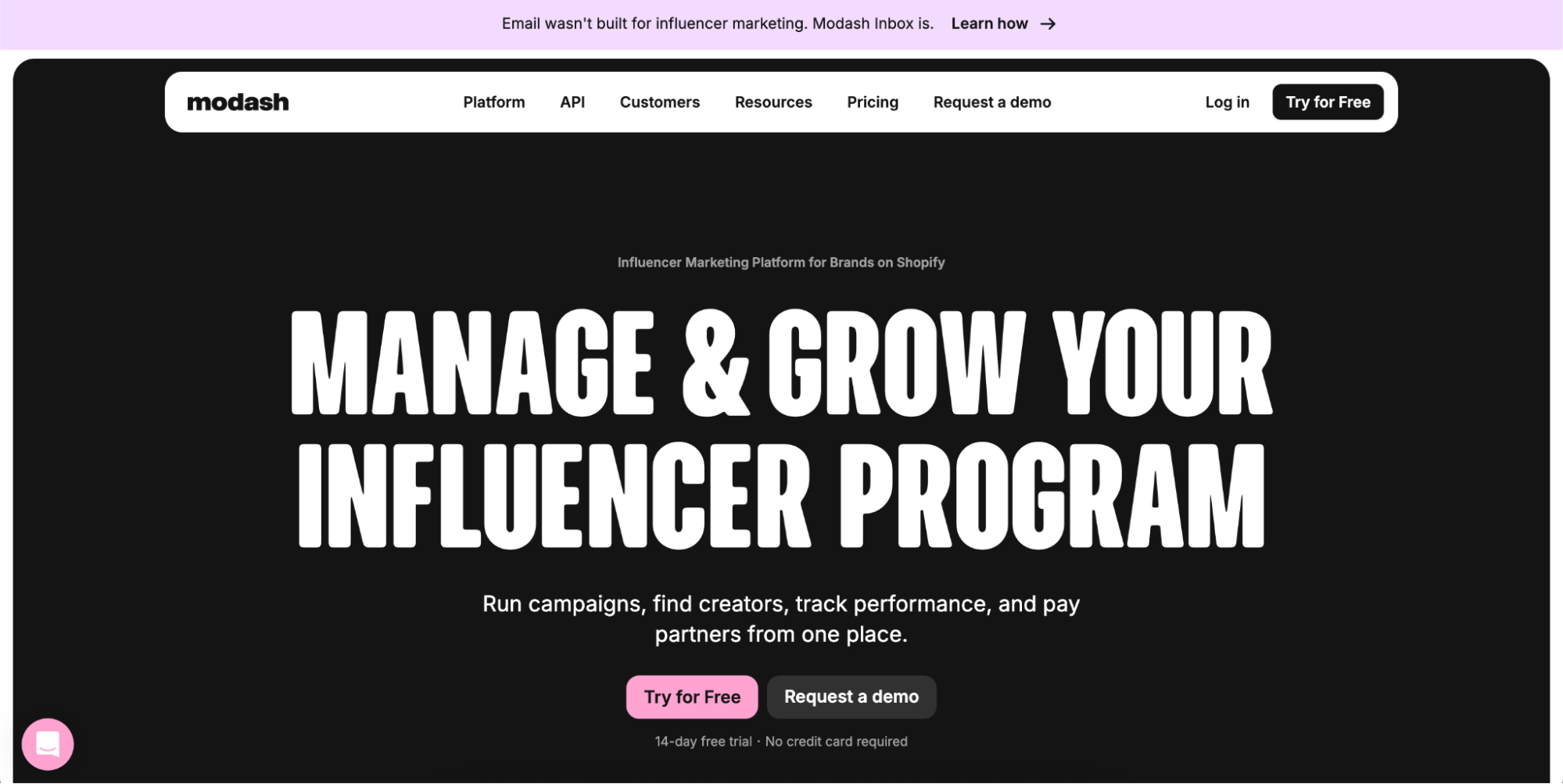
Modash pairs one of the largest public creator databases with Shopify-native workflows for product gifting and affiliate management. Its mid-market pricing and month-to-month flexibility make it particularly attractive for growing eCommerce brands that need strong discovery and affiliate tools without enterprise-level commitments.
Best for: Shopify-based eCommerce brands that want powerful discovery and automated affiliate management at accessible pricing.
Pricing:
- Essentials: $199/month
- Performance: $499/month
- Enterprise: Custom (annual billing)
Standout features:
- 350M+ Public Creator Database: Non-opt-in profiles give you one of the widest discovery nets for finding product-relevant creators.
- AI Visual Discovery: Describe an aesthetic or upload a product image to find creators whose content matches your brand’s visual identity.
- Shopify-Native Gifting & Affiliates: Automated discount codes, UTM tracking, and product selection directly from your Shopify catalog.
- Built-In Outreach & CRM: Bulk email with Gmail/Outlook sync and centralized relationship management.
- Automated Affiliate Payouts: Commission tracking and monthly creator payments processed in-platform.
Modash’s deep integrations only work with Shopify. If your store runs on WooCommerce, Magento, or BigCommerce, you’ll hit a wall immediately. It also lacks native content licensing, whitelisted ad tools, and the AI-powered CRM automation that all-in-one platforms offer for managing complex multi-creator programs.
4. Aspire
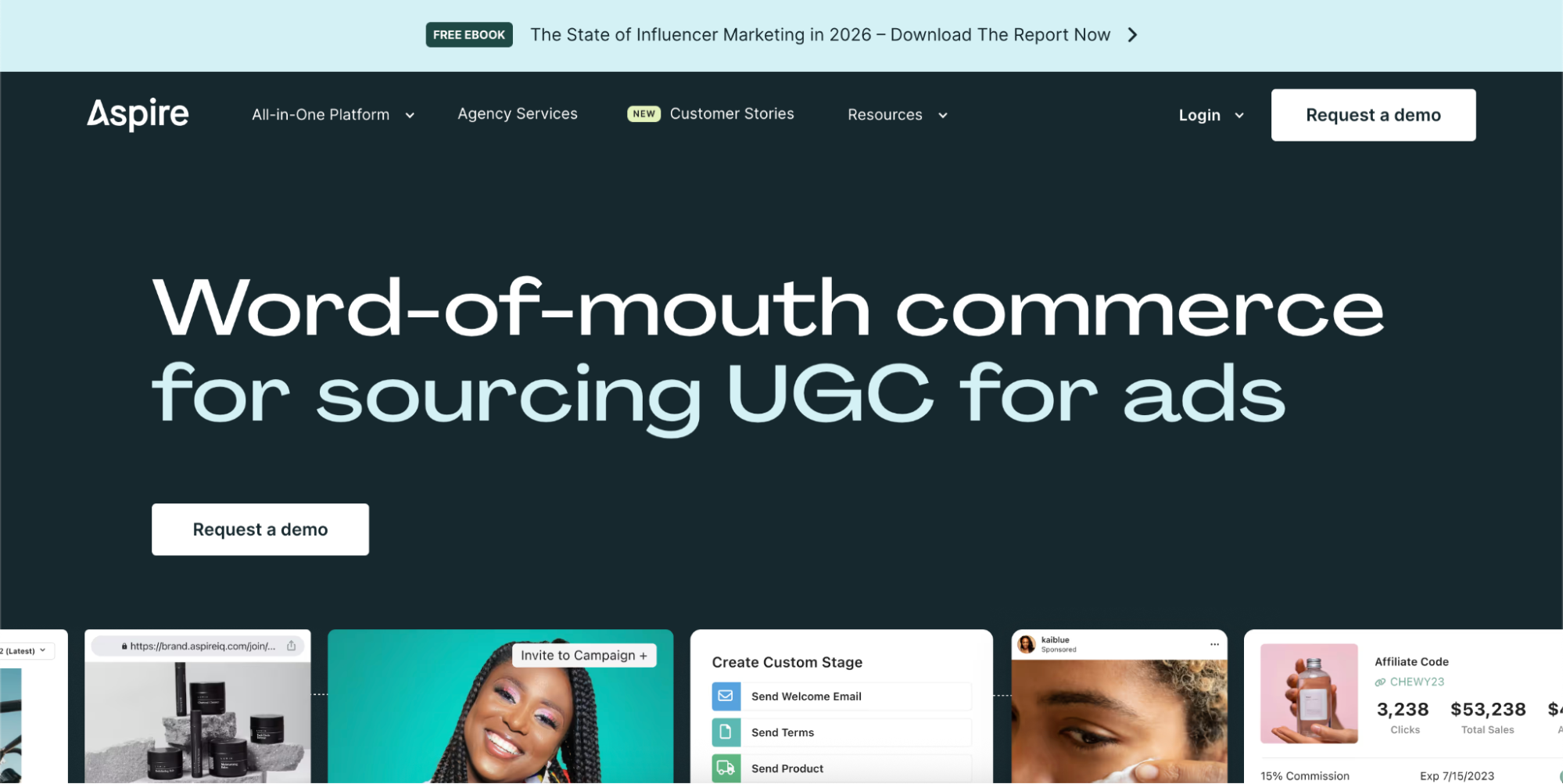
Aspire combines an inbound creator marketplace with first-party social data and structured campaign workflows. Its Shopify fulfillment integration lets creators pick products from your catalog, streamlining the seeding process for brands with strong enough recognition to attract inbound creator interest.
Best for: Mid-market eCommerce brands with established brand awareness that want creators to apply to campaigns rather than relying entirely on cold outreach.
Pricing:
- Custom; mid-tier packages quoted around $2,300/month
Standout features:
- Inbound Creator Marketplace: 1M+ creators actively applying to brand campaigns – reducing the time spent on outbound prospecting.
- First-Party Social Data: Direct API integrations with Meta, TikTok, and Pinterest for reliable audience insights rather than scraped estimates.
- Shopify Fulfillment: Creators browse and select products from your Shopify catalog for seeding campaigns.
- End-to-End Campaign Workflow: Discovery, contracts, content approvals, and performance tracking managed in one pipeline.
- Dedicated Client Support: Strategic onboarding and ongoing guidance included.
Custom pricing at ~$2,300/month limits cost transparency. The inbound marketplace shines for recognized brands but less-known eCommerce stores will still depend heavily on outbound outreach, where platforms with AI-powered personalization and databases of 350M-450M+ creators hold a significant edge.
5. Storyclash
Storyclash stands out for content performance analytics and competitive intelligence. For eCommerce brands, its Shopify integration goes beyond basic tracking – measuring ROAS, customer acquisition cost, and average order value per creator, giving you the unit economics that justify (or cut) individual partnerships.
Best for: eCommerce brands that want content-driven creator selection and per-creator unit economics (ROAS, CAC, AOV) to optimize spend.
Pricing:
- Business plan starts at $870/month
- Enterprise plans available
Standout features:
- AI-Driven Discovery: Image recognition, AI prompts, and lookalike search across 183M creator profiles on Instagram, TikTok, and YouTube.
- Shopify ROAS, CAC & AOV Tracking: Measure return on ad spend, customer acquisition cost, and average order value per creator – the metrics eCommerce teams actually use.
- Historical Content Data: Access expired Stories and past content performance – see what a creator actually delivered, not just what’s currently live.
- Competitive Benchmarking: See which creators your competitors hired, what they posted, and how that content performed.
- Campaign Hub: Centralized collaboration tools for managing active campaigns.
Storyclash lacks built-in contract generation and content licensing workflows – you’ll handle UGC repurposing rights manually. Its 183M database, while solid, is notably smaller than platforms indexing 350M-450M+ profiles. Strong for analytics and competitive intelligence, but it doesn’t replace the need for separate outreach and CRM tools.
6. HypeAuditor
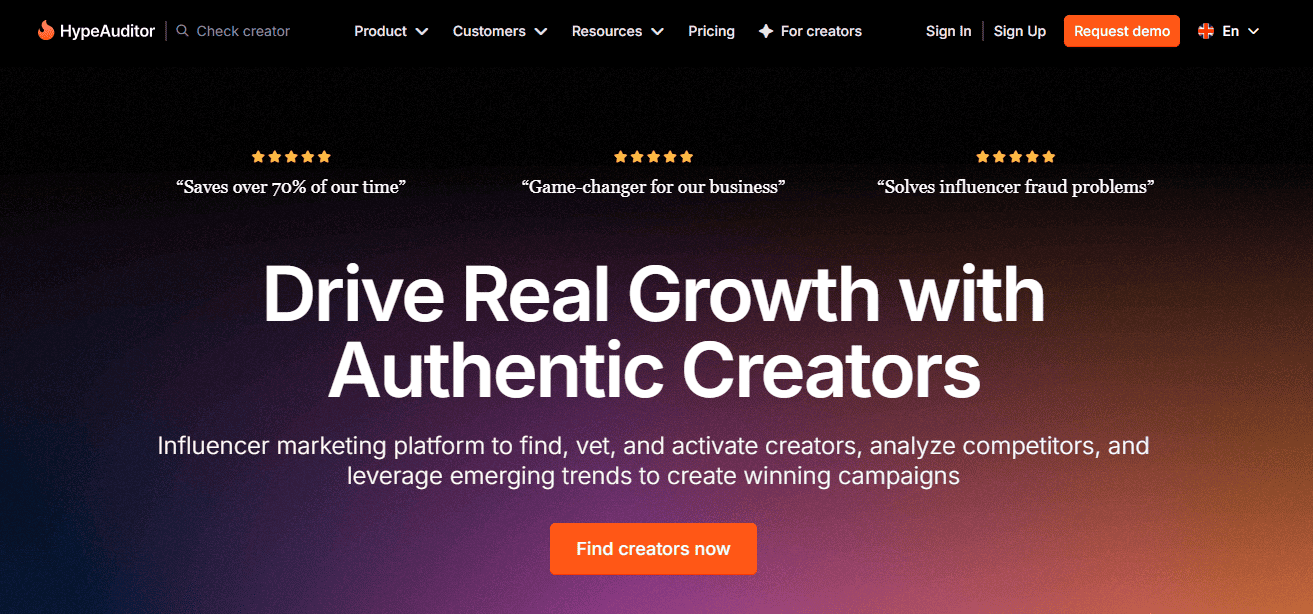
HypeAuditor is the industry standard for influencer auditing and fraud detection. For eCommerce brands where every creator partnership represents product cost and shipping expense on top of fees, validating audience authenticity before committing budget is essential – and HypeAuditor does this better than anyone.
Best for: eCommerce brands that need rigorous audience verification and per-creator revenue attribution through Shopify.
Pricing:
- Business plans start around $10,000/year
- Enterprise plans up to $60,000/year
Standout features:
- Advanced Fraud Detection: Industry-leading audience authenticity analysis, engagement quality scoring, and follower growth pattern identification.
- AI Discovery & Lookalike Search: Find creators similar to your top-performing partners by analyzing captions, images, and audience overlap.
- Shopify Revenue Attribution: Track per-creator revenue through affiliate links to see exactly which partnerships generate sales.
- Social Listening: Monitor hashtags, brand mentions, and competitor activity to identify organic advocates already talking about your products.
- Creator Application Pages: Custom landing pages for creator recruitment and vetting.
HypeAuditor excels at analytics but doesn’t handle campaign execution. No AI-powered outreach, no CRM automation, no product gifting workflows. eCommerce teams adopting HypeAuditor will still need additional tools for the rest of the influencer lifecycle – the kind of multi-tool overhead that platforms with built-in fraud detection eliminate.
7. Later
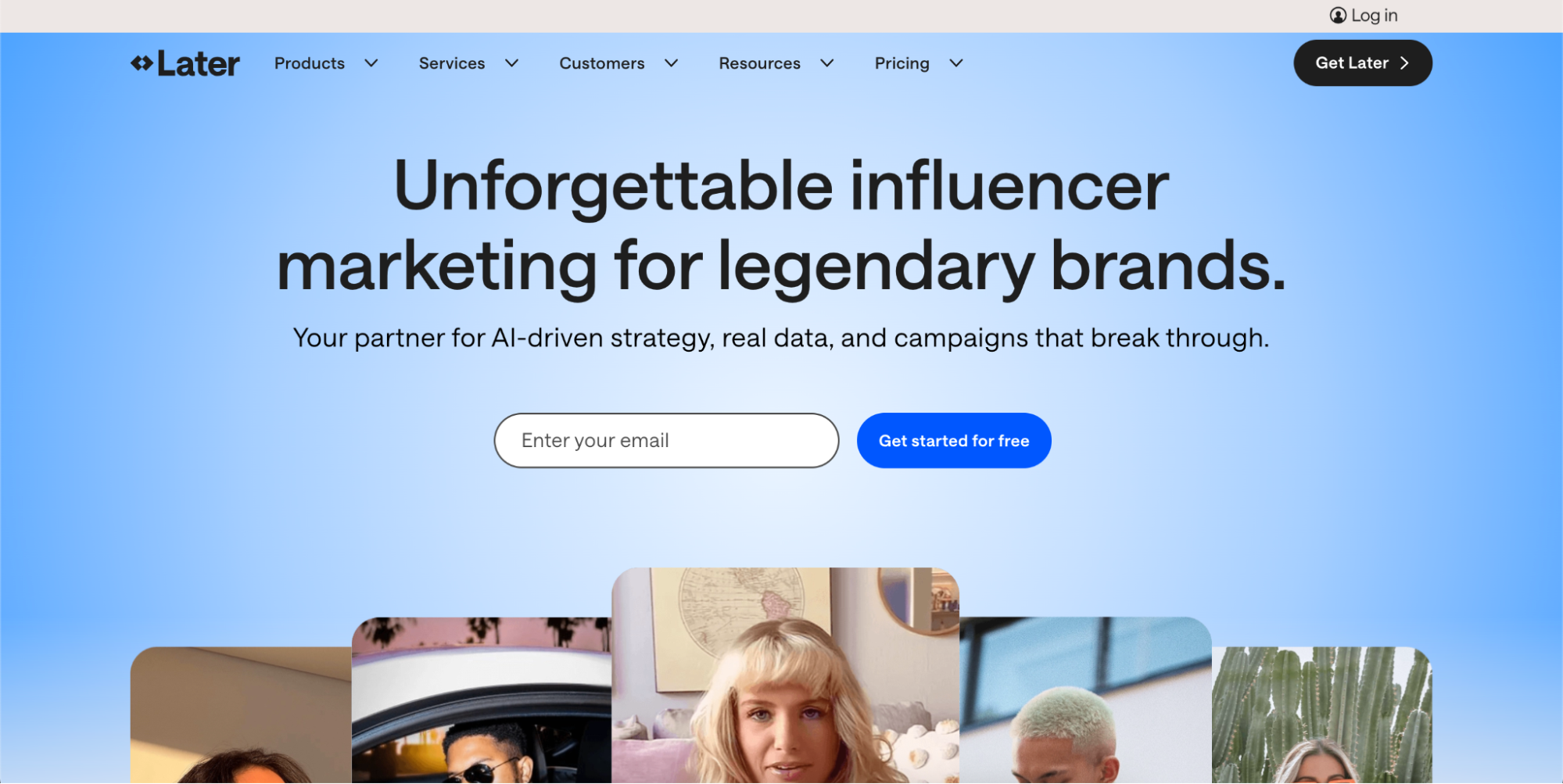
Later integrates influencer marketing into its established social media scheduling platform. For eCommerce brands already using Later for organic content, adding influencer capabilities means aligning creator collaborations with your product launch calendar and promotional content schedule.
Best for: eCommerce brands already using Later for social scheduling that want to layer in influencer campaigns without adding a separate platform.
Pricing:
- Self-serve influencer marketing plans start at approximately $28,500/year
- Pro and full-service options reach $50,000-$60,000/year
Standout features:
- 15M Contactable Creators: Verified email addresses for direct outreach without bouncing or guessing.
- Content Calendar Integration: Plan influencer content alongside product launches and promotional posts in a single view.
- Shopify Gifting & Discounts: Generate discount codes and manage product seeding with inventory tracking.
- Creator Application Pages: Custom pages to attract and vet creator applicants for campaigns.
- Brand Safety Scanning: AI flags potential issues in creator content history before you commit to a partnership.
Later’s influencer plans start at $28,500/year – enterprise pricing for what many brands find are mid-tier capabilities. The unique value (managed services, advanced analytics) requires the $50,000+ tiers. Its 15M database is small compared to platforms indexing 200M-450M+ profiles, and it lacks the AI outreach automation and deep CRM that dedicated influencer platforms provide.
8. Meltwater
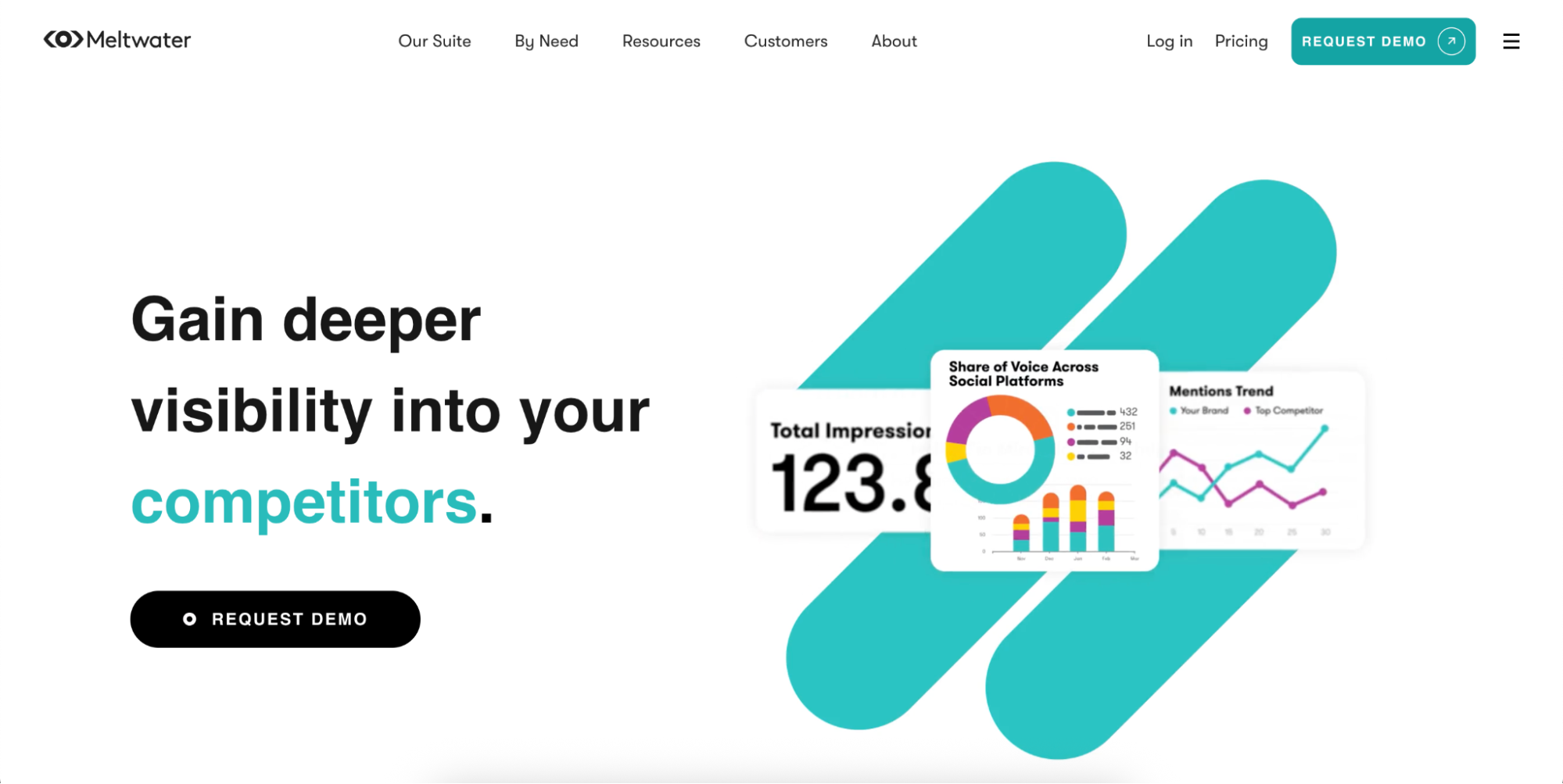
Meltwater combines its Klear influencer marketing platform with media monitoring and social listening. For eCommerce brands that also manage PR and earned media, this combination means influencer campaign data and media intelligence live in one dashboard.
Best for: eCommerce brands with active PR programs that want influencer marketing data integrated into their broader media intelligence stack.
Pricing:
- Klear influencer plans start around $33,100/year (discounted)
- Standard pricing from $50,000+/year
Standout features:
- True Reach Technology: AI estimates real audience reach beyond follower counts by analyzing engagement patterns and audience overlap.
- Visual AI Search: Find creators by uploading product images or describing visual themes.
- Integrated Chat & Payments: Message creators and process payments within the platform.
- Audience Sentiment Analysis: Analyze comment section sentiment to understand how audiences respond to product-related content.
- Cross-Channel Reporting: Influencer campaign data combined with earned media and PR metrics.
At $33,000-$50,000+/year, Meltwater’s pricing is enterprise-grade and only makes sense if you’re using its full media monitoring stack. The 30M influencer database is significantly smaller than competitors, and onboarding the entire ecosystem takes substantial time. eCommerce brands that don’t need PR integration will find better value in dedicated influencer platforms.
9. Heepsy
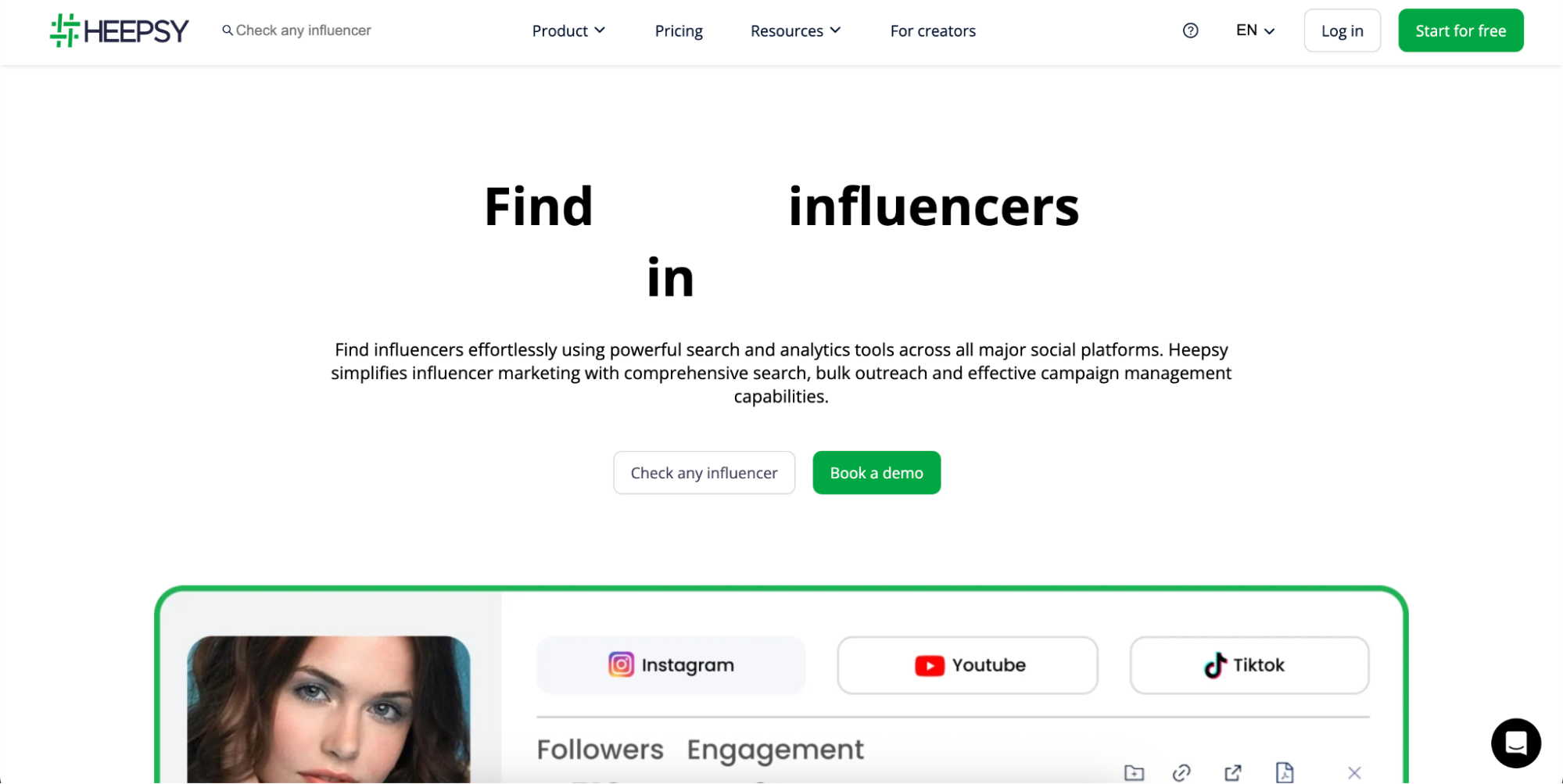
Heepsy is the most budget-friendly option for eCommerce brands testing influencer marketing. A free plan lets you explore the database, and paid tiers starting at $89/month make it accessible for brands that need to prove the channel works before scaling up their investment.
Best for: Early-stage eCommerce brands that need affordable discovery and basic outreach to validate influencer marketing as a revenue channel.
Pricing:
- Free plan available
- Starter: $89/month
- Plus: $249/month
- Advanced: $369/month (required for Shopify sales tracking)
Standout features:
- 50M+ Influencer Database: Strong US and Europe coverage for primary Western eCommerce markets.
- Authenticity Filters: Fake follower detection and audience quality scoring to avoid wasted product sends.
- Kanban-Style CRM: Visual pipeline for tracking creators through campaign stages – intuitive for teams new to influencer tools.
- Shopify & WooCommerce Tracking: Affiliate and discount code tracking on Advanced plans – one of the few budget platforms supporting WooCommerce.
- Bulk Email Outreach: Send up to 3,000 emails per month with follow-up sequences.
Shopify sales tracking and affiliate management require the $369/month Advanced plan – a significant jump from the entry tier. Outreach lacks AI personalization, meaning more manual work as your creator list grows. Heepsy is an excellent starting point, but eCommerce brands scaling past 50 active partnerships will need the automation and CRM depth of a full-suite platform.
10. SocialLadder

SocialLadder turns your existing customers into brand ambassadors. For eCommerce brands, this means the people who already buy your products can become your most authentic content creators – they know the product, they use it, and their recommendations carry genuine credibility.
Best for: eCommerce brands with repeat customers that want to build a community-driven ambassador program alongside paid influencer campaigns.
Pricing:
- Typically under $2,000/month
- 6-12 month commitment recommended
Standout features:
- Customer-First Discovery: Scans your customer lists and social followers to find people who already buy and advocate for your products.
- Post-Purchase Auto-Invite: eCommerce and CRM integration automatically invites customers to your ambassador program after they buy.
- Gamified UGC Challenges: Point-based tasks – unbox and review, share on TikTok, refer a friend – redeemed for store credit or products.
- Built-In Content Usage Rights: Ambassadors agree to content terms on joining – no per-post licensing negotiations.
- Performance Leaderboards: Gamification drives ongoing content creation and healthy competition among ambassadors.
Ambassador programs take months to build momentum, and content volume is less predictable than paid partnerships. SocialLadder works best as a layer on top of a traditional influencer program, not as its replacement. eCommerce brands running both will still need a separate platform for external creator discovery, AI-powered outreach, and CRM management.
Final Thoughts
For eCommerce brands, the right Upfluence alternative comes down to one question: how much of the influencer-to-revenue pipeline does the platform actually cover?
- Full pipeline coverage: Influencer Hero covers discovery through revenue attribution across five eCommerce platforms (Shopify, WooCommerce, Magento, BigCommerce, Prestashop) with AI outreach, CRM automation, product gifting, and creator storefronts. GRIN offers similar depth but limits eCommerce integrations to Shopify and requires $25,000+ annual commitments.
- Strong mid-market options: Modash delivers excellent discovery and Shopify affiliate workflows starting at $199/month. Aspire’s inbound marketplace reduces outreach effort for recognized brands. Both are Shopify-only for deep integrations.
- Analytics and intelligence: Storyclash gives you per-creator ROAS, CAC, and AOV through Shopify. HypeAuditor’s fraud detection protects against wasted product sends. Both are strong as supplements but don’t cover campaign execution.
- Budget entry points: Heepsy’s free plan lets you validate the channel with zero risk. SocialLadder turns existing customers into ambassadors, adding a community layer that complements paid partnerships.
It’s worth noting that many influencer marketing agencies specializing in eCommerce build their operations on these platforms. If you’re not sure which tool fits your store or don’t have the bandwidth to manage an in-house program, working with an agency that already has the infrastructure can accelerate time to results.
The bottom line: every dollar you spend on influencer marketing should be traceable to a transaction. Choose the platform that makes that attribution chain as short and automated as possible.